Industrial pipe buying becomes risky when overseas buyers receive material that does not match the purchase order, project specification, grade, standard, wall thickness, MTC, heat number, or inspection requirement. In export procurement, the problem is not always that the pipe is unavailable. The bigger problem is whether the pipe supplied is the correct pipe, properly certified, traceable, inspected, packed, and suitable for the application.
Many international EPC contractors, oil and gas buyers, refinery procurement teams, power plant buyers, infrastructure companies, industrial stockists, fabricators, and project importers face serious problems when wrong-grade or non-certified pipes are supplied. The material may look correct visually, but if the grade, chemical composition, mechanical properties, schedule, test certificate, or heat number traceability does not match, the shipment can be rejected during inspection or after arrival.
For industrial applications such as oil and gas pipelines, refinery piping, petrochemical plants, boilers, power plants, water transmission lines, offshore projects, chemical processing, marine applications, and structural projects, wrong material can delay installation, increase cost, create safety risk, and damage buyer confidence.
This is why overseas buyers prefer working with an experienced industrial pipe supplier, wholesaler, stockist, and exporter who can support grade-wise sourcing, certified material supply, MTC review, heat number traceability, third-party inspection, export packing, and dispatch documentation.
Kwality Steelage supplies industrial metal pipes for oil and gas, refinery, petrochemical, power, construction, water transmission, offshore, infrastructure, marine, and process industry applications. With a wide range of API 5L, seamless, ERW, LSAW, HSAW, EFW, carbon steel, alloy steel, stainless steel, duplex, and super duplex pipes, Kwality Steelage helps overseas buyers reduce the risk of wrong-grade supply and non-certified material.
The Real Problem: Wrong Pipe Material Is Not Always Visible
One of the biggest challenges in pipe procurement is that wrong material may not be visible from appearance. A pipe may look like stainless steel, carbon steel, alloy steel, or API 5L line pipe, but visual appearance alone cannot prove grade or compliance.
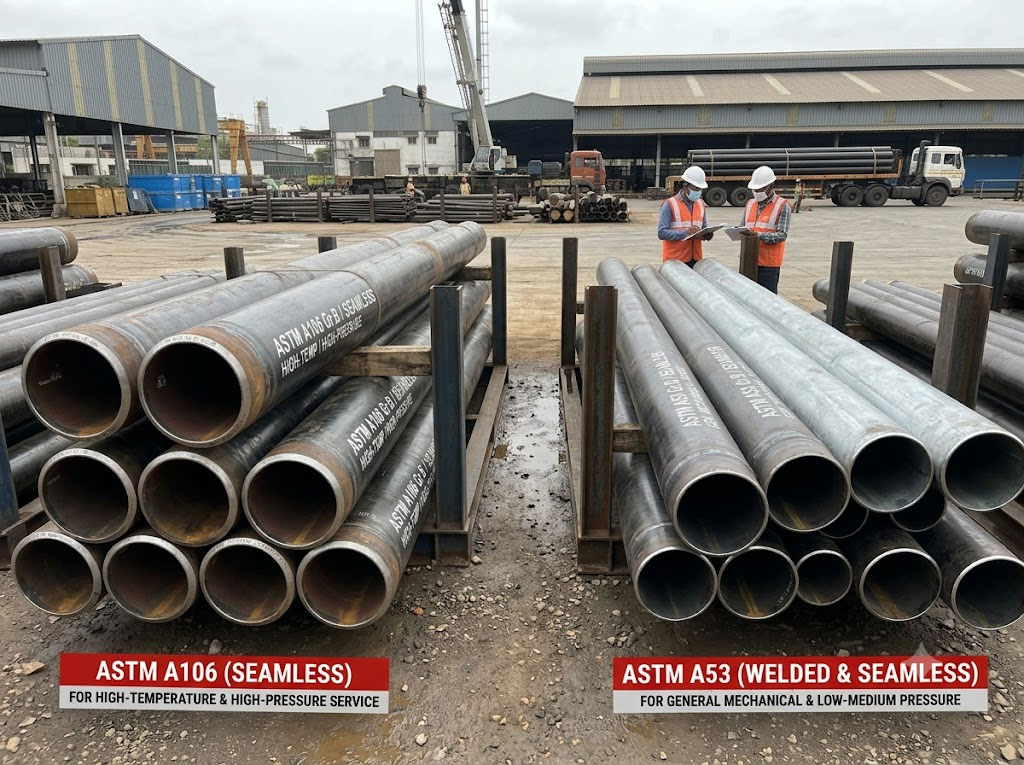
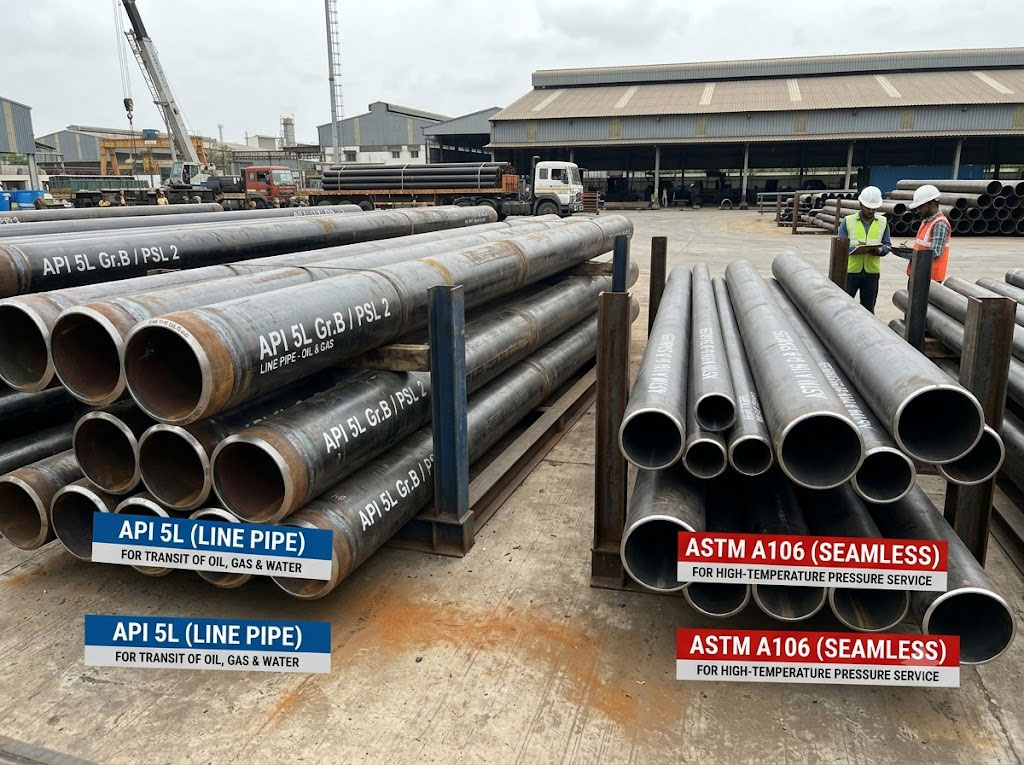
For example, SS 304 and SS 316 may look similar, but they perform differently in chloride or chemical exposure. ASTM A106 Grade B and ASTM A53 may both be carbon steel pipes, but they are not always suitable for the same service. ASTM A335 P11, P22, and P91 may all be alloy steel pipes, but they cannot be used interchangeably without engineering approval.
From a procurement point of view, buyers should never accept material only because the size looks correct. The material must be verified through documents, marking, heat number, MTC, and inspection where required.
Common Wrong-Grade Pipe Buying Problems and Their Impact
| Buyer Problem | What It Can Cause | How Buyers Can Avoid It |
|---|---|---|
| Grade not clearly mentioned | Supplier quotes unsuitable material | Mention exact grade in enquiry and PO |
| Standard not confirmed | Wrong technical compliance | Confirm ASTM, API, ASME or project standard |
| MTC missing | Inspection rejection | Request MTC before dispatch |
| Heat number mismatch | Traceability failure | Match pipe marking with MTC |
| PMI not requested | Wrong stainless/alloy grade risk | Ask for PMI where required |
| Schedule missing | Wrong wall thickness supplied | Mention schedule or exact wall thickness |
| Low-price supplier selected | Higher risk of uncertified material | Check certification and reliability |
| Inspection skipped | Wrong material reaches destination | Arrange third-party inspection for critical orders |
| Packing marks unclear | Site identification problem | Request clear marking and packing list |
| Documents reviewed late | Shipment or approval delay | Review documents before dispatch |
Step One: Mention the Exact Grade, Not Only the Pipe Name
Many wrong-material problems begin with incomplete enquiries. Buyers often write “seamless pipe required,” “stainless steel pipe required,” or “carbon steel pipe required” without mentioning the exact grade.
This creates confusion because every pipe category includes many grades.
For example:
Seamless pipe may mean ASTM A106, ASTM A53, ASTM A333, ASTM A335, ASTM A312 or another standard.
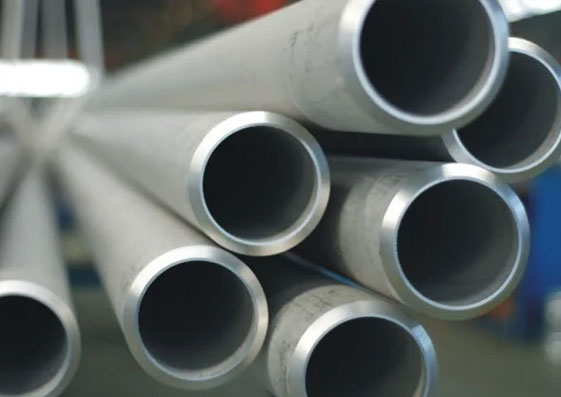
Stainless steel pipe may mean 304, 304L, 316, 316L, 321, 347, 904L, duplex or super duplex.
Alloy steel pipe may mean ASTM A335 P5, P9, P11, P22, P91 or P92.
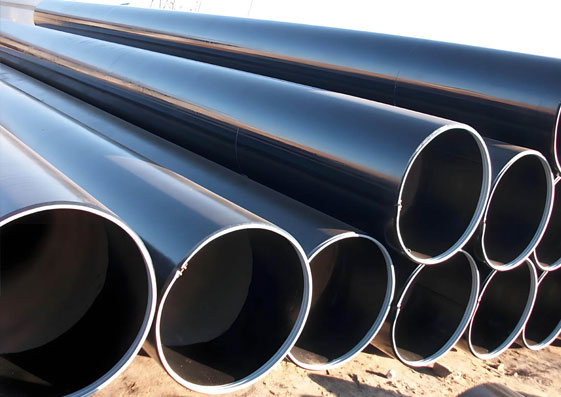
Line pipe may mean API 5L Grade B, X42, X52, X60, X65, X70 or another grade.
To avoid wrong-grade supply, buyers should mention the exact grade and standard in the enquiry and purchase order.
A correct enquiry should say:
ASTM A106 Grade B seamless pipe
API 5L X52 PSL2 line pipe
ASTM A335 P22 alloy steel seamless pipe
ASTM A312 TP316L stainless steel seamless pipe
ASTM A672 EFW pipe with required class
This removes confusion and helps the supplier quote correctly.
Step Two: Confirm Standard, Grade, Size and Schedule Together
Grade alone is not enough. A buyer must also confirm the standard, size, schedule or wall thickness, quantity, length, and pipe type.
Wrong-grade issues often happen when the enquiry has some details but not the full specification. For example, the buyer may mention ASTM A106 Grade B but forget to mention schedule. The supplier may quote the wrong wall thickness. Or the buyer may mention SS 316 pipe but not confirm whether seamless or welded pipe is required.
A complete pipe specification should include:
Pipe standard
Grade
Pipe type
NPS or OD
Schedule or wall thickness
Quantity
Length
End finish
Application
Testing requirement
MTC requirement
Inspection requirement
Packing requirement
Destination port
Delivery timeline
When these details are clear, the risk of wrong material supply reduces significantly.
If your industrial pipe requirement needs certified material, share your full grade, standard, size, schedule and documentation requirement with Kwality Steelage for proper quotation support.
Step Three: Review MTC Before Dispatch
Material Test Certificate is one of the most important documents for avoiding wrong-grade pipe supply. It helps verify the grade, chemical composition, mechanical properties, heat number, testing, and compliance with the purchase order.
Buyers should not wait until the material arrives to check MTC. The certificate should be reviewed before dispatch.
A buyer should check:
Does the MTC mention the correct grade?
Does it mention the correct standard?
Does the heat number match the pipe marking?
Does the chemical composition match the grade?
Do mechanical properties meet the requirement?
Are size and product details correct?
Is the MTC linked to the supplied material?
Are test results available where required?
For critical projects, MTC review should be part of the pre-dispatch approval process.
Step Four: Match Heat Number with Pipe Marking
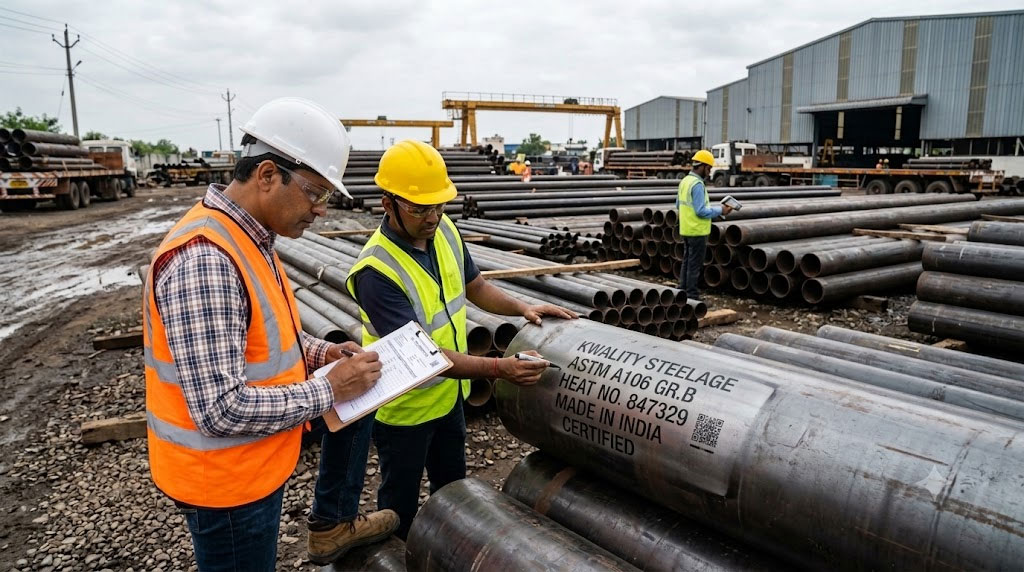
Heat number traceability is the link between the physical pipe and the test certificate. If heat number on the pipe does not match the MTC, the buyer may not be able to prove material identity.
This is especially important in mixed-size and mixed-grade shipments. If several grades are packed together, clear marking becomes critical.
Buyers should request:
Heat number marking on material
Grade marking
Size marking
Standard marking
PO or project marking, where required
Bundle-wise identification
Packing list matching with material
Heat number mismatch can create inspection rejection, site confusion, and approval delay.
Step Five: Use PMI Testing for Stainless Steel and Alloy Steel Pipes
Positive Material Identification testing is useful when buyers want to verify stainless steel, alloy steel, duplex, super duplex, or special alloy grades. PMI helps confirm the presence of key alloying elements and reduces the risk of grade mix-up.
PMI is especially useful when the order includes:
SS 304 and SS 316 together
SS 316 and 904L material
Duplex and super duplex pipes
ASTM A335 alloy steel grades
Nickel alloy or special alloy materials
Mixed-grade shipment
Critical project supply
PMI does not replace all mechanical testing, but it helps verify material identity before shipment.
| Material Type | Why PMI May Be Useful |
|---|---|
| Stainless Steel Pipes | Helps confirm 304, 316, 321, 904L and other grades |
| Alloy Steel Pipes | Helps verify alloy elements in P11, P22, P91 and related grades |
| Duplex / Super Duplex Pipes | Helps reduce grade mix-up risk |
| Mixed-Grade Shipments | Helps segregate material correctly |
| Critical Project Supply | Adds verification before dispatch |
Step Six: Arrange Third-Party Inspection for Critical Orders
Third-party inspection helps overseas buyers reduce risk when buying industrial pipes for critical applications. The inspection agency can check material, documents, marking, quantity, dimensions, surface condition, packing, and compliance with the purchase order.
Inspection may include:
Visual inspection
Dimensional inspection
Document review
MTC verification
Heat number verification
PMI witnessing
Hydro test review
UT or RT report review
Quantity check
Marking verification
Packing inspection
For high-value, urgent, high-pressure, or critical service orders, third-party inspection can help identify issues before shipment.
Step Seven: Avoid Substitution Without Engineering Approval
Sometimes suppliers offer alternate grades when the exact material is not available. In some cases, alternate material may be acceptable. But buyers should never accept substitution without engineering approval.
Examples of risky substitution include:
SS 304 instead of SS 316
ASTM A53 instead of ASTM A106
ASTM A335 P11 instead of P22
API 5L PSL1 instead of PSL2
Welded pipe instead of seamless pipe
Lower schedule instead of specified wall thickness
Even if the substitute is cheaper or faster, it may not match the application.
A safe rule: if the purchase order requires a specific grade, standard, PSL level, schedule, or pipe type, do not change it unless the project engineer or client approves it in writing.
Step Eight: Check Supplier Capability, Not Only Price
Wrong-grade and non-certified material risk increases when buyers select suppliers only by lowest price. Industrial pipe procurement should not be treated like a simple commodity purchase when material is going into oil and gas, refinery, power, petrochemical, chemical, or pressure systems.
Before selecting a supplier, buyers should check:
Does the supplier understand the standard and grade?
Can the supplier provide MTC?
Can heat number traceability be maintained?
Can inspection be arranged?
Can PMI be supported where required?
Can export documents be prepared properly?
Can packing and marking be handled correctly?
Can the supplier meet the timeline realistically?
The cheapest quote can become expensive if the material is rejected or replaced later.
Wrong Grade vs Certified Material: Buyer Checklist
| Checkpoint | What Buyers Should Verify |
|---|---|
| Grade | Exact grade matches enquiry and PO |
| Standard | ASTM / API / ASME standard is correct |
| Pipe Type | Seamless, ERW, LSAW, HSAW, EFW or welded type is correct |
| Schedule | Wall thickness matches project requirement |
| MTC | Certificate matches material and purchase order |
| Heat Number | Pipe marking matches MTC |
| PMI | Required for stainless, alloy, duplex or critical material |
| Inspection | Third-party inspection arranged if needed |
| Packing List | Size, grade, quantity and marking details match |
| Export Documents | Invoice, packing list, COO and shipping documents are correct |
Certified Pipe Enquiry Checklist for Export Buyers
| Detail Required | Why It Matters |
|---|---|
| Pipe standard | Confirms technical compliance |
| Grade | Prevents wrong material selection |
| Pipe type | Confirms seamless, ERW, LSAW, HSAW, EFW or welded |
| Size / NPS / OD | Identifies dimension |
| Schedule / wall thickness | Confirms pressure and weight |
| Quantity | Helps stock and shipment planning |
| Length | Affects availability and packing |
| Application | Helps understand service risk |
| MTC requirement | Confirms traceability |
| PMI requirement | Helps verify grade where required |
| Third-party inspection | Reduces shipment risk |
| Packing requirement | Protects and identifies material |
| Destination port | Helps export planning |
| Delivery timeline | Helps confirm feasibility |
A complete enquiry helps Kwality Steelage provide accurate quotation, document support, and export supply coordination.
How Buyers Can Reduce Risk Before Payment and Dispatch
Before payment or dispatch, overseas buyers should make a final document and material check. This reduces the chance of receiving wrong-grade or uncertified material.
A safe process should include:
Confirm final purchase order details
Review MTC
Match heat number with material marking
Confirm size and schedule
Check quantity and packing list
Confirm inspection requirement
Request PMI, where required
Approve shipping marks
Confirm export packing
Review invoice and dispatch documents
This process is especially important for urgent orders and project-based shipments.
Why Kwality Steelage Supports Certified Industrial Pipe Supply
Kwality Steelage supports overseas buyers with industrial metal pipe supply where grade accuracy, documentation, traceability, inspection, and export packing matter.
As a supplier, wholesaler, stockist, and exporter, Kwality Steelage helps buyers source industrial pipes based on technical requirements, project specifications, and export documentation needs.
The company can support requirements for:
API 5L pipes
Seamless pipes
ERW pipes
LSAW pipes
HSAW pipes
EFW pipes
Carbon steel pipes
Alloy steel pipes
Stainless steel pipes
Duplex pipes
Super duplex pipes
For buyers handling oil and gas, refinery, petrochemical, power, water transmission, offshore, infrastructure, construction, chemical, and process industry projects, Kwality Steelage can support grade-wise sourcing, MTC documentation, inspection coordination, export packing, and dispatch planning.
When Should You Contact Kwality Steelage?
You should contact Kwality Steelage when your pipe requirement involves certified material, exact grade selection, MTC, heat number traceability, PMI, third-party inspection, urgent dispatch, export packing, or project documentation.
Buyers can share:
Pipe standard
Grade
Pipe type
Size
Schedule or wall thickness
Quantity
Length
Application
MTC requirement
PMI requirement
Inspection requirement
Packing requirement
Destination port
Delivery timeline
With these details, Kwality Steelage can provide more accurate quotation and help reduce wrong-grade procurement risk.
Conclusion
International buyers can avoid wrong-grade or non-certified industrial pipes by clearly mentioning the exact standard, grade, pipe type, size, schedule, quantity, documentation requirement, inspection requirement, and packing requirement before placing the order.
The most important safeguards are MTC review, heat number traceability, clear marking, PMI testing where required, third-party inspection for critical orders, and supplier reliability.
Wrong material can create inspection rejection, customs delay, project-site confusion, installation problems, and long-term performance risk. The safest approach is to work with an experienced industrial pipe supplier, wholesaler, stockist, and exporter who understands certified material supply and export documentation.
Kwality Steelage supports overseas buyers with API 5L, seamless, ERW, LSAW, HSAW, EFW, carbon steel, alloy steel, stainless steel, duplex, and super duplex pipe supply for export projects.
For certified industrial pipe enquiries, share your grade, standard, size, schedule, quantity, inspection requirement, and delivery timeline with Kwality Steelage to receive a project-focused quotation.
FAQs
How can international buyers avoid wrong-grade industrial pipes?
Buyers can avoid wrong-grade pipes by clearly mentioning exact grade, standard, pipe type, size, schedule, MTC requirement, inspection requirement, and documentation needs before placing the order.
Why is MTC important in industrial pipe buying?
MTC verifies material grade, chemical composition, mechanical properties, heat number, testing details, and compliance with the purchase order.
What is heat number traceability?
Heat number traceability links the physical pipe to its material test certificate. It helps prove that the supplied material matches the tested material.
Can wrong pipe grade be identified visually?
No. Many pipe grades look similar. Buyers should verify grade through MTC, heat number, marking, PMI, and inspection where required.
What is PMI testing in pipe supply?
PMI, or Positive Material Identification, helps verify alloy content and material grade, especially for stainless steel, alloy steel, duplex, super duplex, and mixed-grade shipments.
When should buyers request PMI testing?
Buyers should request PMI testing for stainless steel, alloy steel, duplex, super duplex, special alloy, mixed-grade, or critical project supply where grade verification is important.
Why is third-party inspection useful?
Third-party inspection helps verify material, dimensions, documents, marking, quantity, packing, and compliance before shipment.
What are common wrong-grade pipe mistakes?
Common mistakes include using SS 304 instead of SS 316, ASTM A53 instead of ASTM A106, P11 instead of P22, PSL1 instead of PSL2, welded pipe instead of seamless pipe, or wrong schedule.
Can buyers accept alternate pipe grades?
Alternate pipe grades should only be accepted if approved by the project engineer, client, or technical specification. Substitution should not be accepted casually.
Why should buyers not choose pipes only by lowest price?
The lowest price may involve wrong material, missing documents, poor traceability, no inspection support, or weak packing. This can increase project cost later.
What details should buyers share for certified pipe supply?
Buyers should share standard, grade, pipe type, size, schedule, quantity, application, MTC requirement, PMI requirement, inspection requirement, packing requirement, destination port, and timeline.
Can Kwality Steelage support certified pipe export requirements?
Yes. Kwality Steelage supports industrial pipe export requirements with grade-wise sourcing, MTC documentation, inspection coordination, export packing, and dispatch planning.
What industries need certified industrial pipes?
Certified industrial pipes are required in oil and gas, refinery, petrochemical, power, chemical, marine, water transmission, infrastructure, construction, offshore, and process industry projects.
Why is clear marking important in pipe shipments?
Clear marking helps identify grade, size, standard, heat number, PO number, and package details. It reduces site confusion and material mix-up.
When should document review be done?
Document review should be done before dispatch, not after shipment. This helps avoid inspection rejection, customs delay, and project approval issues.